
Inspect GOOSE identity, sequence, timing and payload context; use bounded SMV capture where the workflow applies.
GOOSE analysis →Independent sessions · unified values · attributable diagnostics
Monitor several IEC 61850 IEDs without mixing their engineering state.
ARSAS gives each IED its own association, discovered model, selected signals, reporting state, events, file workflow, control context and diagnostics while still providing project-wide live-value and evidence views.
Investigation workflow
When something happens, follow the evidence from network behavior to the disturbance record.
ARSAS keeps these views connected by IED and engineering context. Start with the clue you have; move deeper only when the next source can answer a new question.
Keep signal reference, state, quality, IED time, receive context and acquisition source together.
Event evidence →Stay inside the originating IED session, scan remote files and preserve completeness and transfer state.
Retrieve records →Open the record in ARSAS and inspect synchronized analog/digital evidence, trigger position and protection channels.
See native analysis →Compare the available times and states across sources while keeping clock, source and acquisition differences visible.
Review evidence boundaries →Correlation is not automatic causation proof.GOOSE capture time, IED event time, Reporting receive time and COMTRADE time can come from different clocks and acquisition paths. ARSAS helps keep them reviewable; protection acceptance still requires the approved test method and independent engineering checks.
Independent lifecycleConnect, discover, monitor and disconnect each IED separately
Unified valuesSearch selected signals across devices without losing ownership
Bounded eventsKeep SOE, report reasons and recent changes attributable
Isolated diagnosticsSeparate association, service, report, frame and device behavior
Project workflow
Scale from one relay to a complete test lineup.
Multi-device work becomes unreliable when one global connection, one polling loop or one generic event list owns every relay. ARSAS keeps the runtime boundary per IED and combines only the evidence intended for project-wide views.
Create each device session
Add approved endpoints or SCL-derived device context and retain a clear identity for every relay, bay controller or gateway.
Discover and select independently
Each IED owns its live model, chosen signals, DataSets, RCBs, control objects and file-service state.
Monitor with an attributable source
Values and events keep the originating device, quality, timestamp, reason and acquisition path visible.
Review project-wide evidence
Search and compare selected points across devices without collapsing their diagnostics or lifecycle into one ambiguous session.
Real application evidence
Independent device sessions with unified engineering views.
The screenshots show the working application handling multiple IEDs, shared live-value review and device-attributable diagnostics.
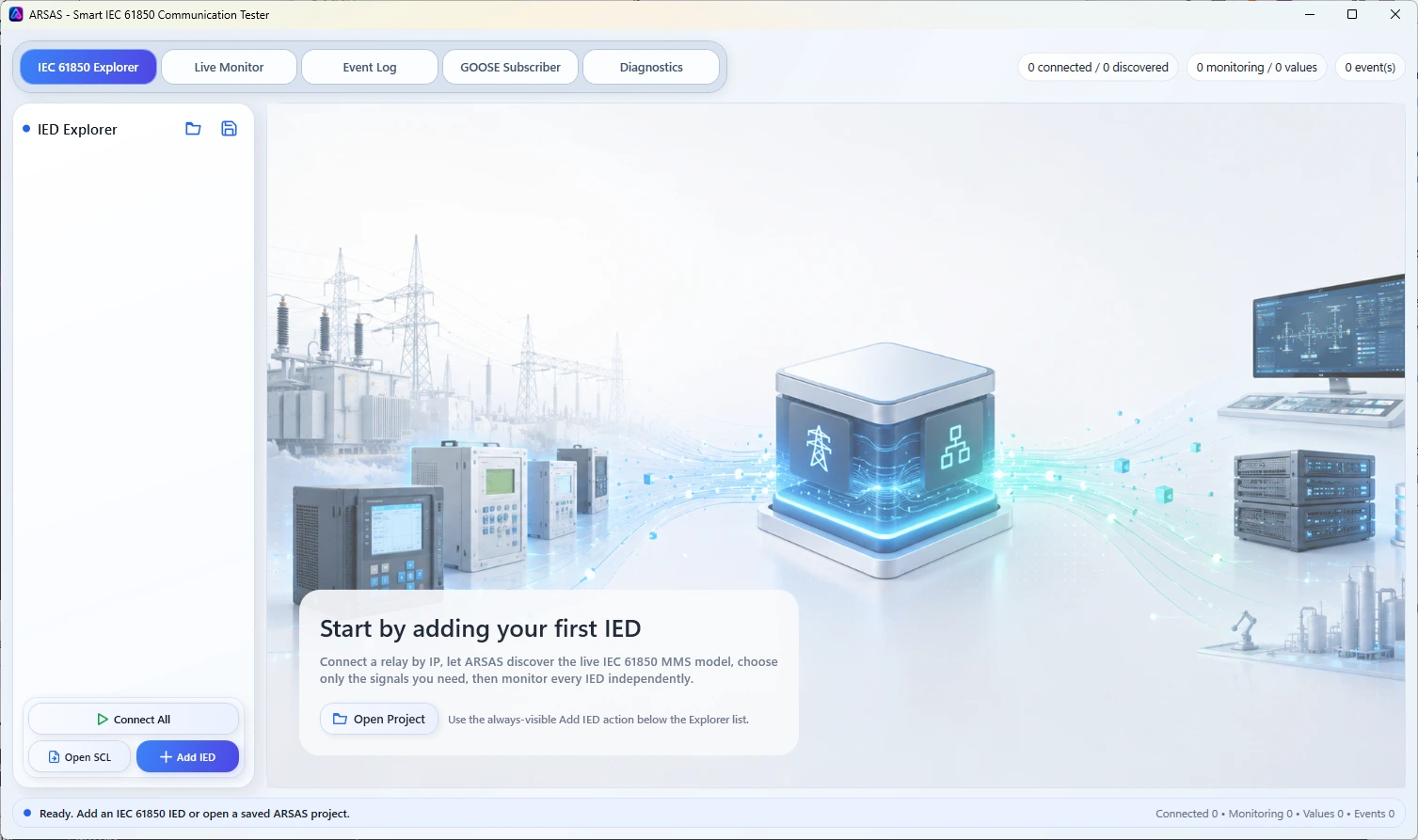
01Independent IED sessions
Each device retains its own connection, model, monitoring and diagnostic state.
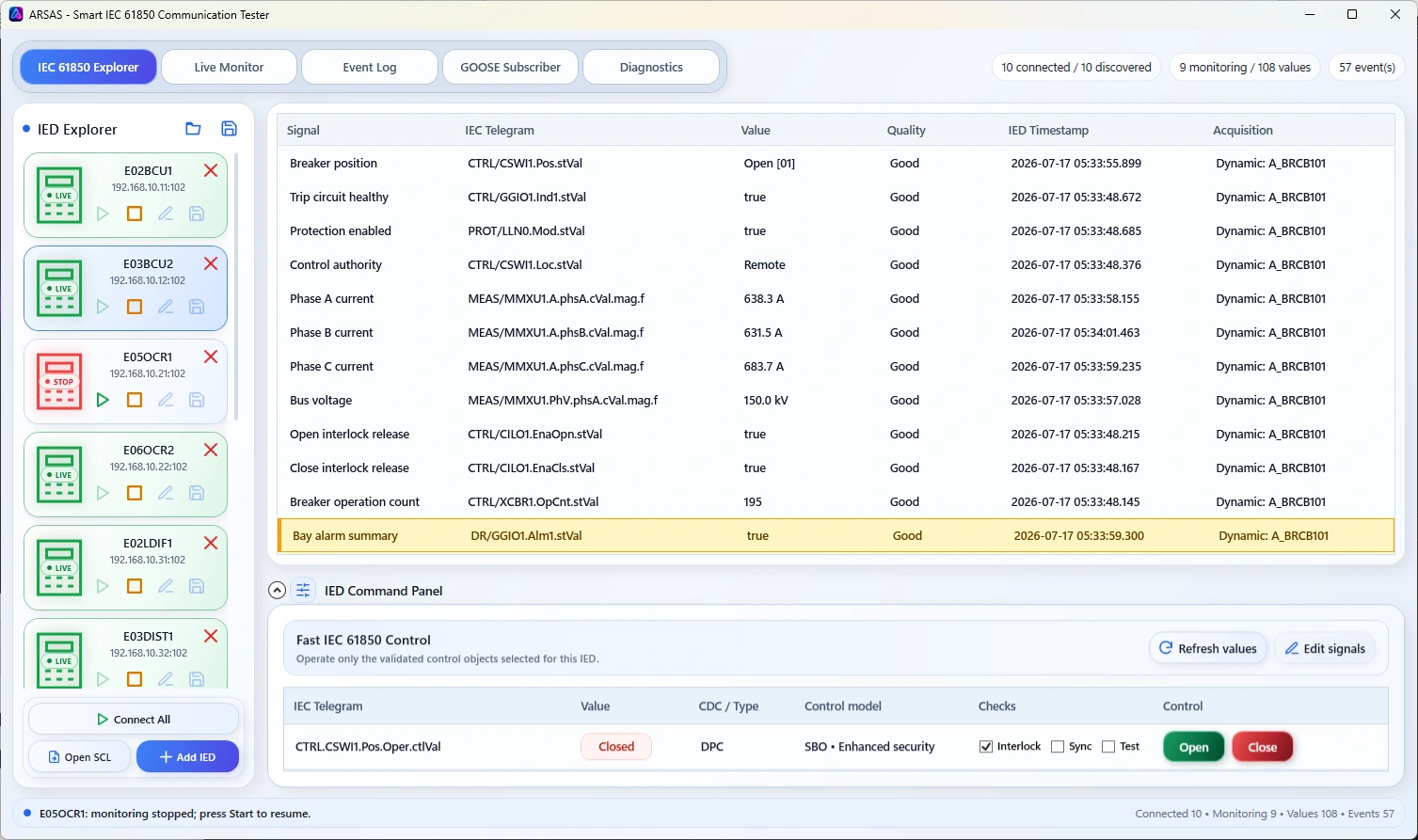
02Unified selected values
Search across devices while retaining source, quality, timestamp and acquisition evidence.
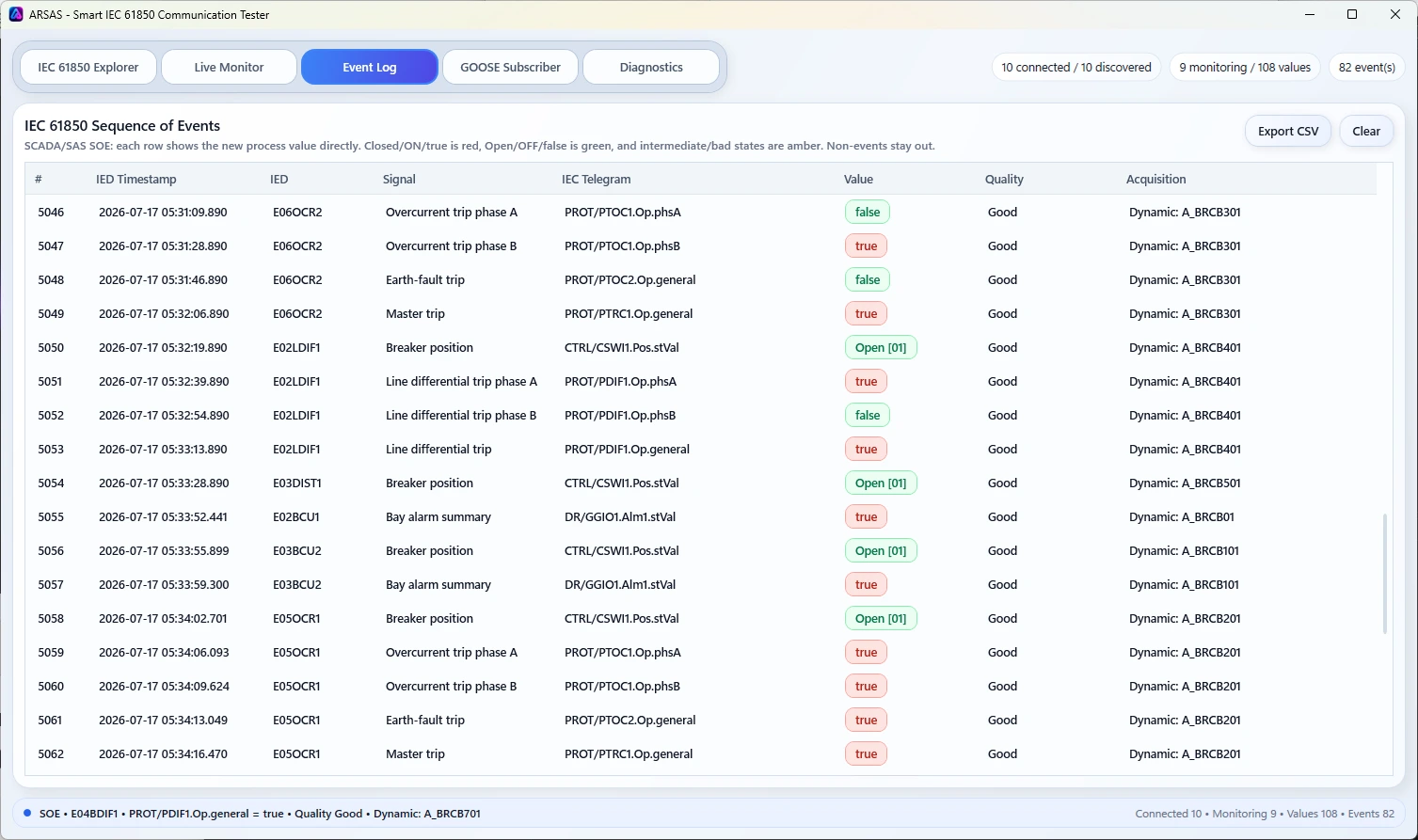
03Bounded event evidence
Separate semantic events from continuous live values and keep the originating IED visible.
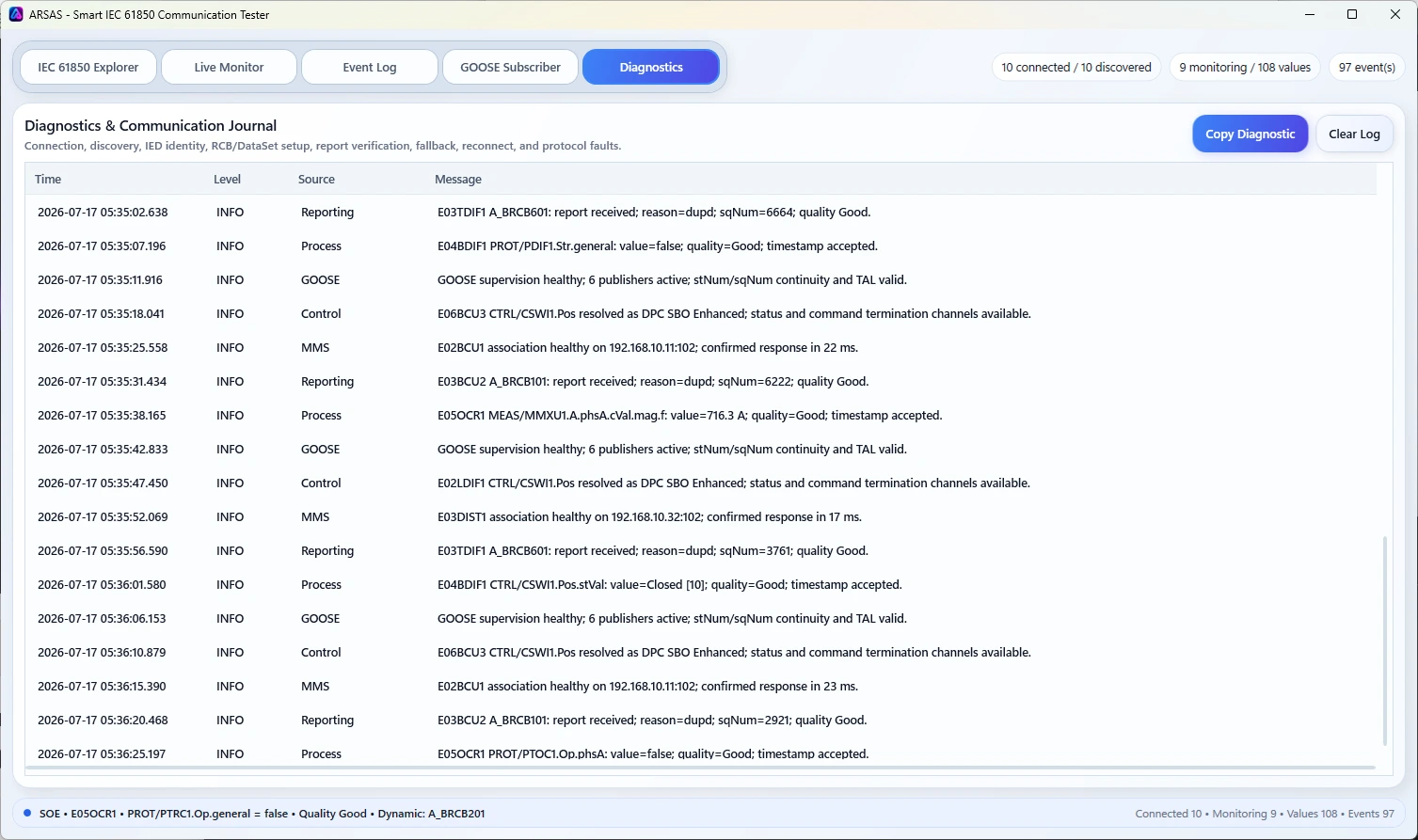
04Attributable diagnostics
Distinguish network, association, report, service and device-specific failures.
FAT lineups, SAT and commissioning projects
- Monitor several relays or bay devices from one workspace
- Compare similar signals across multiple IEDs
- Track SOE and report behavior without losing device ownership
- Retrieve files from the correct relay session
- Keep control and diagnostic context separated
Scale without turning the UI into the protocol engine.
ARSAS uses per-IED runtime ownership, bounded collections, coalesced UI updates and virtualized engineering grids. The objective is responsive engineering work—not uncontrolled background polling or repainting every value continuously.
Build each session from live MMS discovery.
Browse the model, select signals and retain current type and reporting context per IED.
Retrieve fault records without mixing devices.
Keep directory browsing, downloads and transfer diagnostics attached to the originating relay.
Verified stable · ARSAS 1.6.41
Ready for an approved Windows workstation?
Installer and portable packages share the same application scope. Verify the published SHA-256 and review the release boundary before field use.
Release notes, limitations and signing status →