
IO List FAT evidence
Import approved digital indications, bind to the intended IED, require OFF → ON → OFF, and export Excel, native PDF or a resumable .arsas project.
Start from an approved IO List, IED endpoint or SCL source. ARSAS keeps the tested device, observed live behavior and reviewable evidence connected as the project moves from FAT to SAT, commissioning and multi-vendor investigation.
The IO List workspace is a read-only test-plan layer for imported SDI points. General FAT and engineering workflows continue to cover discovery, reporting, GOOSE, files, SCL and guarded control.
Import approved digital indications, bind to the intended IED, require OFF → ON → OFF, and export Excel, native PDF or a resumable .arsas project.
Validate the complete live model, selected signals, reports, GOOSE, control outcomes, disturbance-record access and integration output before shipment.
Reconfirm endpoint access, reporting, station-bus behavior, generated or supplied SCL and downstream system integration after installation.
Investigate live behavior, sequence evidence, communication quality, file services and command completion during controlled commissioning.
Recover from unusable vendor files, generate or normalize bounded SCL and isolate identity, DataSet, RCB, reporting and GOOSE mismatches.
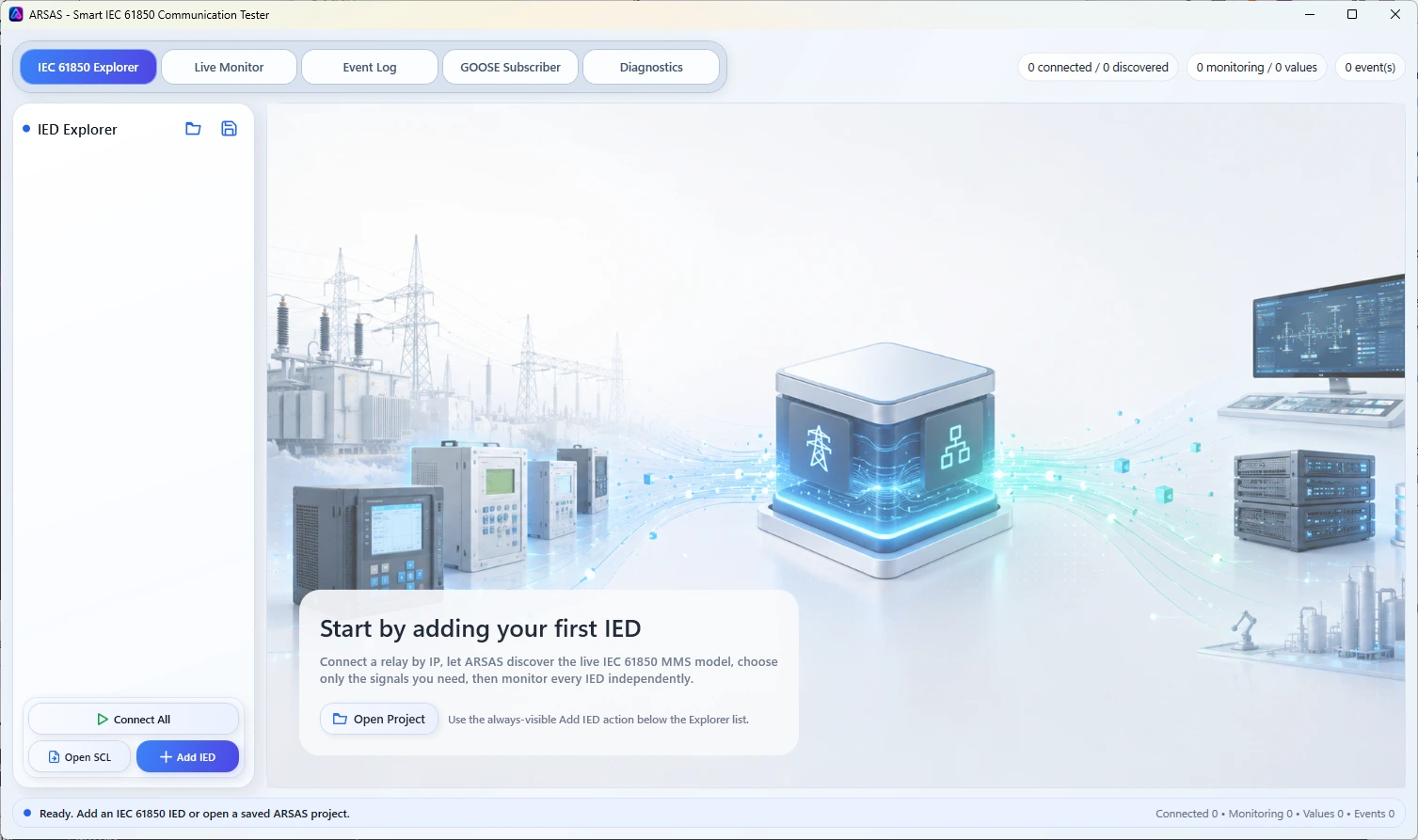
Use General IEC 61850 Testing for endpoint-led engineering. Use FAT / IO List Testing for imported SDI plans and durable transition evidence. Both retain the originating IED and explicit evidence boundaries.
Use an IO List for repeatable indication proof, or use the endpoint and SCL context to investigate broader IEC 61850 services. Preserve what happened and what still requires review.
It does not replace approved procedures, calibrated test equipment, protection-setting verification, switching authority, witness acceptance, formal signatures, target-system import validation or vendor responsibility.
Installer and portable packages share the same application scope. Verify the published SHA-256 and review the release boundary before field use.
Release notes, limitations and signing status →