
Receive selected changes efficiently
Use reports when the IED should deliver events and value changes without polling every object at the same interval.
Smart Reporting turns selected IED signals into a visible acquisition plan. ARSAS starts with usable reads, inspects configured DataSets and Report Control Blocks, proves exact coverage, uses approved recovery only when permitted, and keeps polling visible for anything still uncovered or unverified.
ARSAS treats engineering data as evidence, not just screen output. The exact fields depend on the workflow, but the source and acquisition context should remain visible whenever they exist.
IEC 61850 Reporting lets the IED push selected changes instead of waiting for the client to read every point repeatedly. A BRCB can buffer report entries across a temporary client interruption; a URCB delivers while the association is active without buffered continuity. ARSAS shows whether each update came from a report or polling and does not hide gaps behind a generic “live” label.
Reporting depends on a known IED, known object references and an acquisition requirement that can be checked against actual DataSet membership.
Use reports when the IED should deliver events and value changes without polling every object at the same interval.
Keep report, polling and fallback evidence explicit while validating indications, measurements and sequence behavior.
An association can work while the DataSet is empty, the RCB is occupied, triggers are wrong or no report is delivered.
Reporting state, ownership and degradation for one IED must not silently change the behavior of another session.
ARSAS should first inspect existing DataSets, BRCBs and URCBs. Dynamic DataSet or RCB recovery is conditional, device-dependent and only appropriate when the IED capability and approved procedure permit modification.
The ordered list of data members attached to a report. A convincing name is not proof that the required points are present.
The control object that references a DataSet and governs enablement, trigger options, integrity period, optional fields and delivery behavior.
A Buffered Report Control Block can retain report entries for later delivery when buffering is supported, correctly configured and the client resumes within the applicable continuity limits.
An Unbuffered Report Control Block delivers while the association is active. Events that occur during disconnection are not recovered as buffered history.
General Interrogation requests a current image. Integrity reporting can periodically refresh the DataSet. Neither alone proves spontaneous change triggers work.
Data change, quality change and data update triggers determine which changes can produce reports. The expected event must match the configured trigger behavior.
The workflow starts with evidence that works now, then improves report coverage without turning unavailable reports into invisible data loss.
Start only after the intended IED model is known and selected points can be read with understandable identity, quality and timestamp.
Define the points needed for monitoring or test evidence. Keep their full object references and Functional Constraints.
Read DataSet members, BRCB and URCB references, reservation or ownership state, trigger options, optional fields and enablement conditions.
Compare every selected signal with actual DataSet membership and order. Do not infer coverage from a DataSet or RCB name.
Prefer suitable configured reporting. Consider temporary DataSet or RCB recovery only when writes are permitted, the target is available and rollback is defined.
Change a known test point, confirm report reason and source where available, and keep uncovered, rejected or degraded points in bounded polling.
The update carries attributable IED context, report source and supporting quality and time evidence. BRCB or URCB behavior remains specific to the actual IED configuration.
Polling can be a deliberate bounded fallback for uncovered, occupied, rejected or degraded report paths. Its source and interval must remain visible.
Invalid quality, unknown ownership, incomplete coverage or ambiguous delivery should remain unresolved rather than being promoted to a false pass.
Confirm the IED session and direct reads before changing report configuration.
Read the actual member list and compare it with the selected points.
Inspect ownership and reservation without forcing takeover from another client.
Check trigger options, data-change behavior, report enablement and whether the test stimulus changes the correct attribute.
Inspect report reason, sequence, entry state, optional fields, association continuity and diagnostics before trusting the stream.
Re-evaluate ownership, enablement, BRCB continuity and fallback state. Do not reuse stale acquisition claims from the previous association.
The same workspace can show selected values from independent IED sessions while preserving device, reference, quality, timestamp, recent-change evidence and report or polling source.
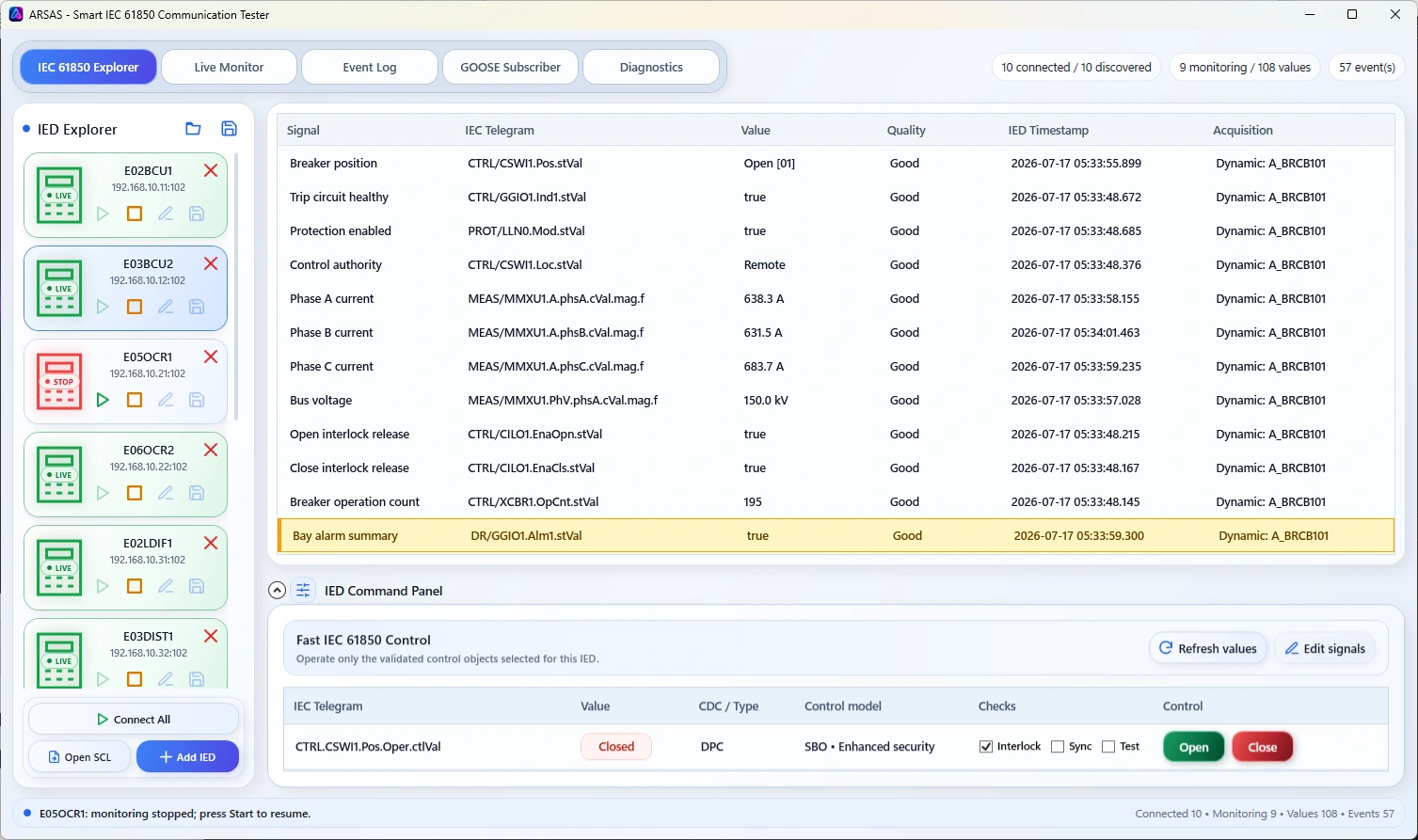
Selected signals retain IED identity, value, quality, time, recent-change state and acquisition source instead of collapsing all updates into one generic live state.
ARSAS can show configured report objects, exact selected-point coverage, current delivery source, fallback state and negative diagnostics for the active IED session.
Successful Reporting on one IED, DataSet or RCB does not prove all vendor implementations, triggers, buffered continuity or receiving systems behave the same. Configuration writes and active test stimuli still require approval.
After report delivery is attributable, continue to GOOSE sequence analysis, IO List FAT or broader FAT workflows without losing device identity, quality, time and source.
Installer and portable packages share the same application scope. Verify the published SHA-256 and review the release boundary before field use.
Release notes, limitations and signing status →