
Do not stop at the operate response.
Wait for the supported completion path, capture CommandTermination and AddCause where available, then compare the resulting status or position feedback within the approved test window.
Keep the initial service result, CommandTermination, AddCause, timing and process feedback as separate evidence. Collapsing them into one “success” or “failed” label hides the actual control path.
Wait for the supported completion path, capture CommandTermination and AddCause where available, then compare the resulting status or position feedback within the approved test window.
The client, communication service, control model, device interlocking and physical process can each produce a different outcome. Preserve the timeline.
Keep object reference, ctlModel, command type, value, origin, checks and selected association.
A positive acknowledgement means the request reached a certain service stage, not necessarily that operation completed.
Retain CommandTermination, AddCause and timing instead of replacing them with a generic message.
Check the resulting status, quality, timestamp and event evidence from the same IED context.
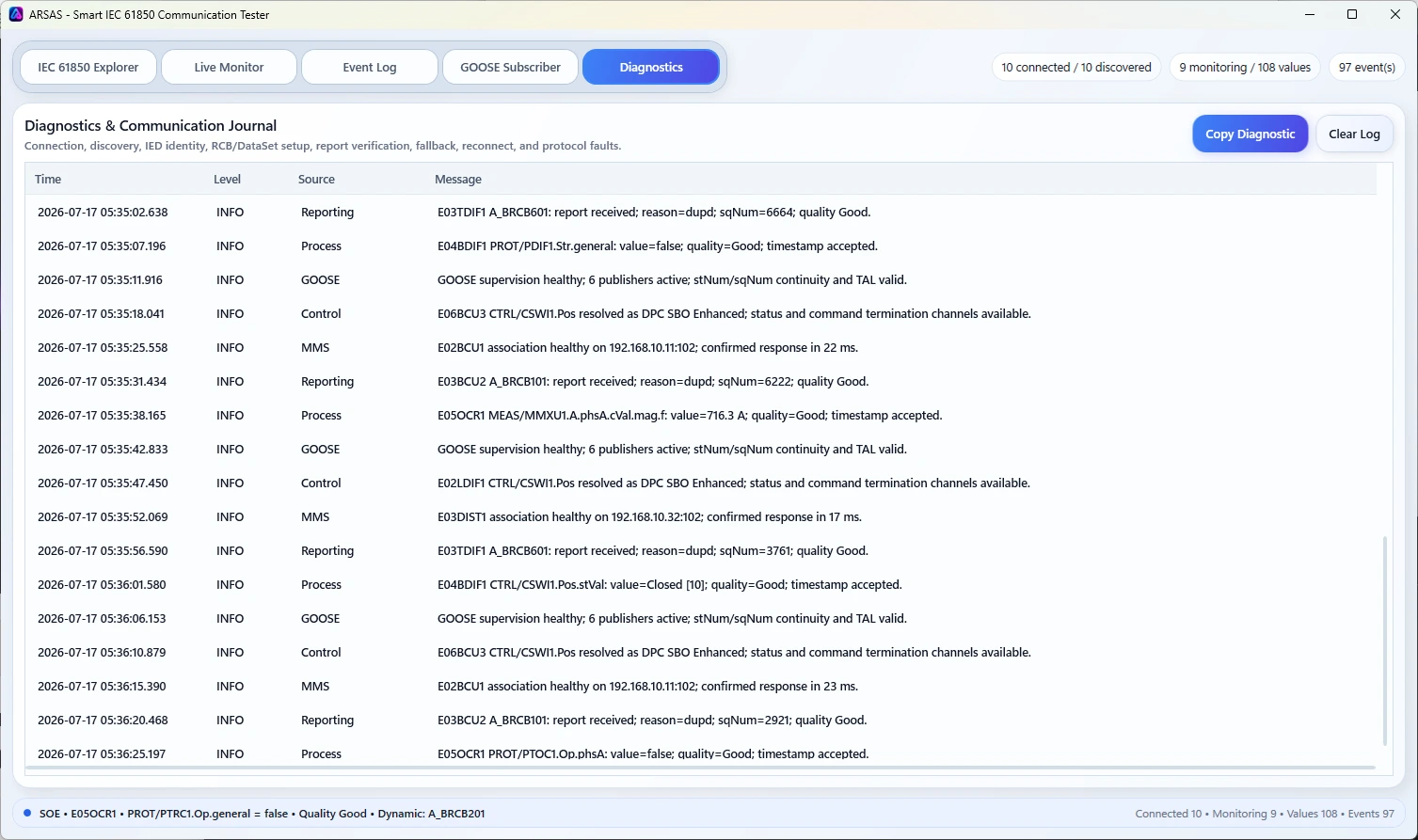
ARSAS retains service and diagnostic context so rejected or incomplete control paths can be investigated instead of hidden.
The service layer may accept the request while device logic later blocks or fails the operation.
Independent status, event and process evidence remains necessary before declaring the test objective complete.
Compare Direct and SBO behavior or open the Smart Control capability page.
ARSAS can expose live model, report, GOOSE, file, control and diagnostic evidence. Final conclusions still depend on the approved project design, vendor documentation, test procedure, network access and independent verification.
Reviewed 20 July 2026 for practical IEC 61850 laboratory, FAT, SAT, commissioning and troubleshooting use.
Installer and portable packages share the same application scope. Verify the published SHA-256 and review the release boundary before field use.
Release notes, limitations and signing status →