
State number
A new published state is normally associated with a state-number change. Confirm that the ordered payload or relevant status also changed as expected.
Interpret sequence evidence together with goCBRef, DataSet, APPID, VLAN, source MAC, TAL and payload. One counter alone is not enough to identify the stream.
A new published state is normally associated with a state-number change. Confirm that the ordered payload or relevant status also changed as expected.
Retransmissions of the current state normally advance sequence evidence. Gaps, resets or unexpected patterns require context from capture continuity and publisher restart behavior.
First prove that consecutive frames belong to the same publisher and control block. Then examine state, sequence, retransmission interval and TAL behavior.
Use source and destination MAC, APPID, VLAN, goCBRef and DataSet reference.
Compare stNum with the ordered allData payload and the expected process event.
Inspect sqNum progression and frame timing while the state remains unchanged.
Separate a publisher that exceeded its advertised lifetime from a local capture interruption or interface problem.
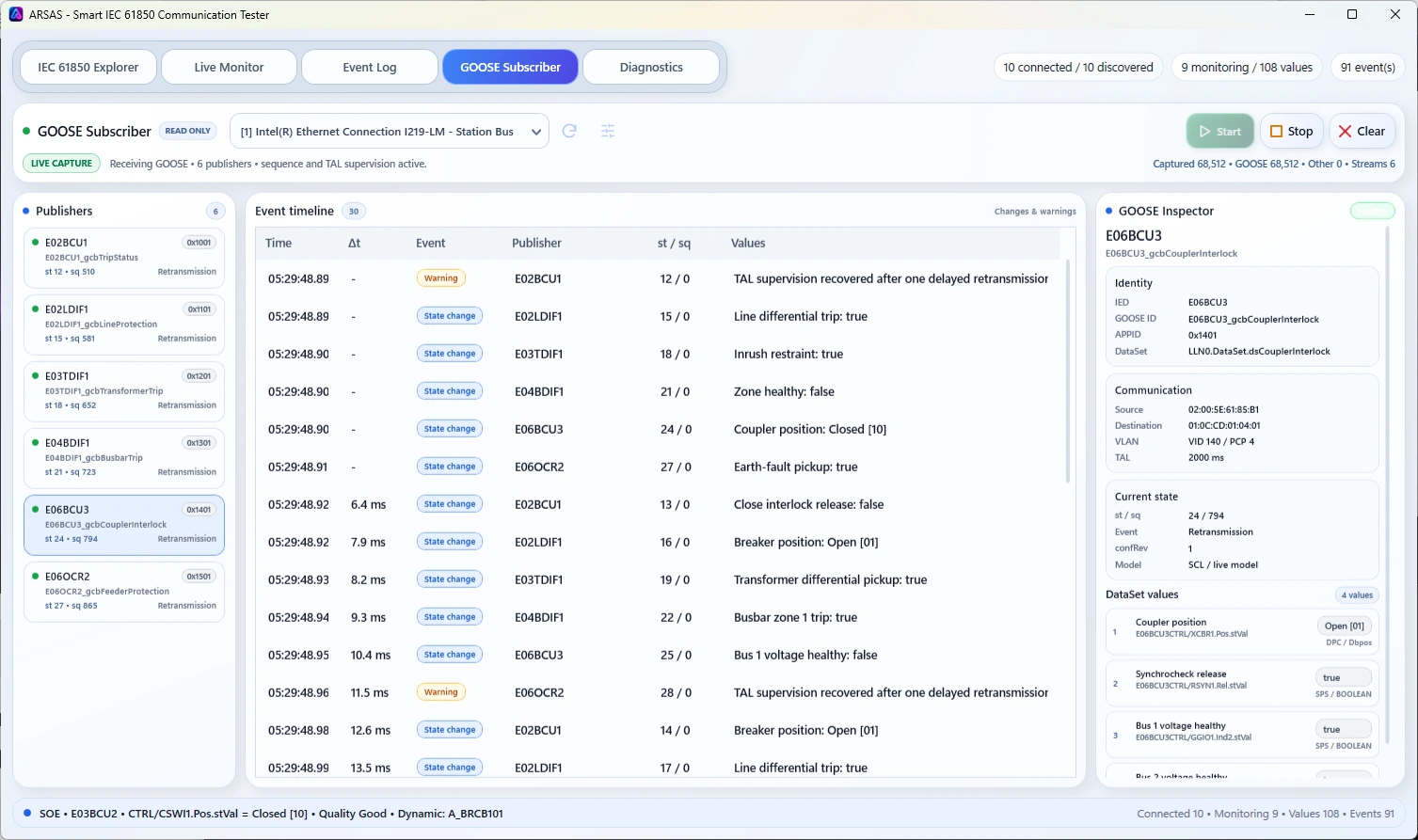
ARSAS keeps stream identity, flags, TAL, counters and ordered payload visible in one GOOSE session.
Publisher restart, configuration activation or capture discontinuity can change the observed pattern. Correlate the timing with device and project events.
The stream can be timely and internally consistent while the DataSet order, scaling or subscriber mapping is wrong.
Review the analyzer capability and multi-vendor integration path.
ARSAS can expose live model, report, GOOSE, file, control and diagnostic evidence. Final conclusions still depend on the approved project design, vendor documentation, test procedure, network access and independent verification.
Reviewed 20 July 2026 for practical IEC 61850 laboratory, FAT, SAT, commissioning and troubleshooting use.
Installer and portable packages share the same application scope. Verify the published SHA-256 and review the release boundary before field use.
Release notes, limitations and signing status →