IEC 61850 MMS · Modbus TCP · MQTT

Learn the protocols. Bridge relay data. Build a clean HMI route.

ARServer is a Windows engineering gateway and information center for turning selected IEC 61850 IED values into practical Modbus TCP maps and MQTT topics for HMI, SCADA, DCS, FAT, relay bench, dashboard, and substation automation workflows.

Source
IEC 61850 MMS
Outputs
Modbus TCP + MQTT
Use case
HMI / SCADA / FAT
License
Apache-2.0
Gateway Runtime
IED sourceOCR7SR12 / MMS :102

Associated · runtime cache healthy

Modbus TCP30001 → CB Position
MQTTarserver/IED/tag/state

Learning center

A practical starting point for IEC 61850, Modbus TCP, and MQTT.

Use ARServer as a product and as a learning map. The goal is to make protocol relationships clear before users start mapping real values.

Protocol 01

IEC 61850 and MMS

Understand IEDs, logical nodes, data objects, data attributes, function constraints, SCL files, and why MMS commonly uses TCP port 102.

Protocol 02

Modbus TCP for HMI/SCADA

Learn why classic DCS, HMI, and SCADA tools prefer stable register maps, status bits, input registers, and deterministic address planning.

Protocol 03

MQTT for data platforms

Learn how topic names, JSON payloads, quality, timestamps, and broker routing make relay data usable for dashboards and middleware.

Use case center

Find the workflow that matches your real integration problem.

ARServer can be used as an HMI/SCADA bridge, a FAT/SAT visibility layer, or an MQTT publishing route. Each use case explains what to map, what to validate, and what to avoid.

Zero to running

From relay IP or SCL file to a working Modbus/MQTT gateway.

The documentation path is designed for a first-time user: install, add source, select signals, validate, map, publish, and troubleshoot.

01

Install and open

Run ARServer on Windows and understand what the workspace shows before starting runtime.

02

Add IED source

Start from live relay IP over MMS port 102 or from SCL/CID/SCD/ICD/IID engineering files.

03

Validate signals

Select SCADA-friendly points, probe readability, and keep value, quality, timestamp, and stale status visible.

04

Publish outputs

Expose stable Modbus TCP points and optional MQTT topics for HMI, SCADA, dashboards, or test tools.

Architecture

Relay data enters once, then fans out to the systems that need it.

ARServer sits between IEC 61850 IEDs and practical consuming systems. It keeps the relay read path controlled, then exposes selected values to classic control systems through Modbus TCP and modern data workflows through MQTT.

  • Relay / IED remains the source of truth over IEC 61850 MMS.
  • ARServer validates selected values before publishing outputs.
  • DCS, HMI, and SCADA tools can poll the Modbus TCP server.
  • IoT dashboards, middleware, or historians can subscribe through MQTT.

Product screenshots

Actual ARServer workflow screens.

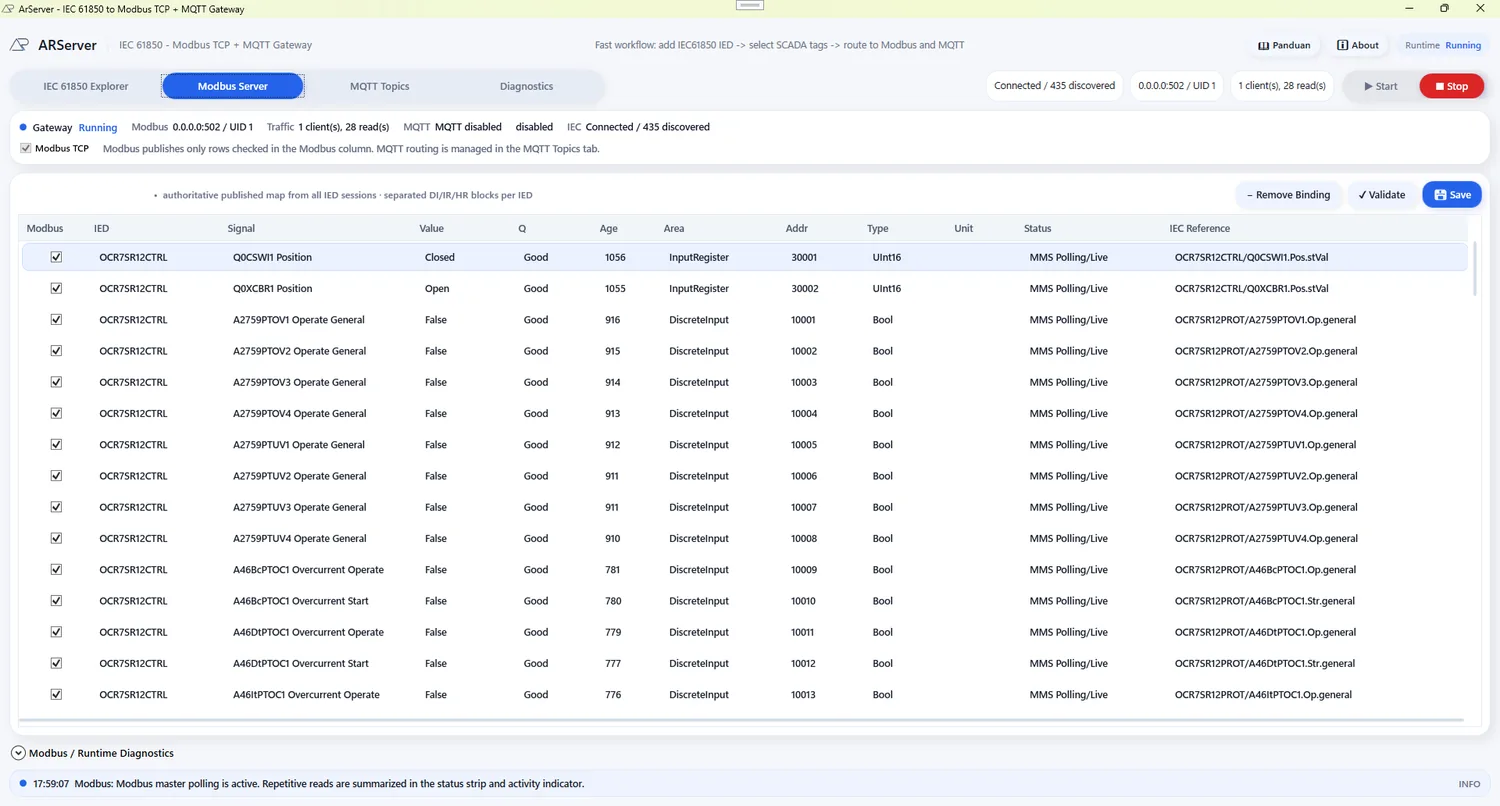
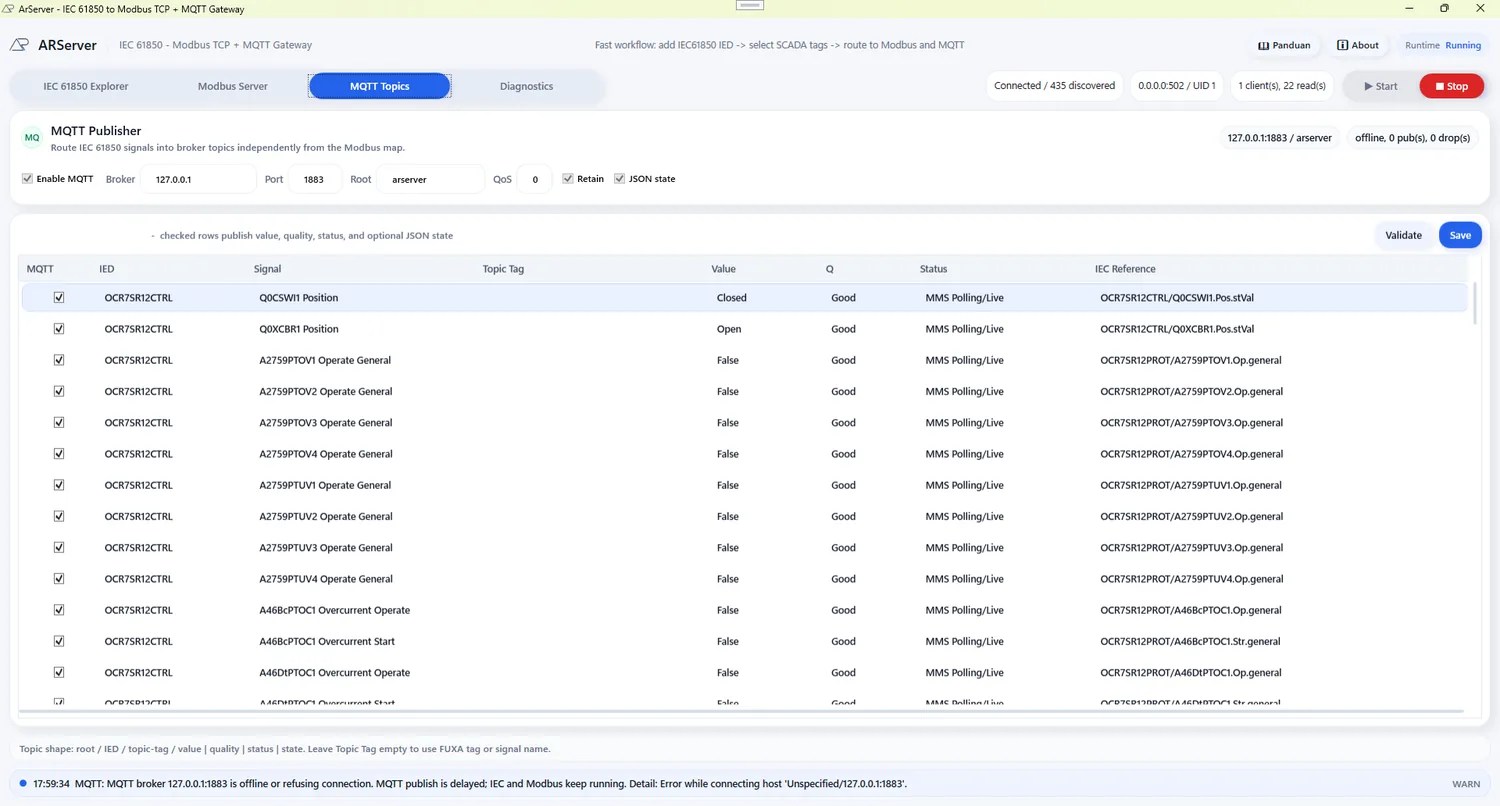
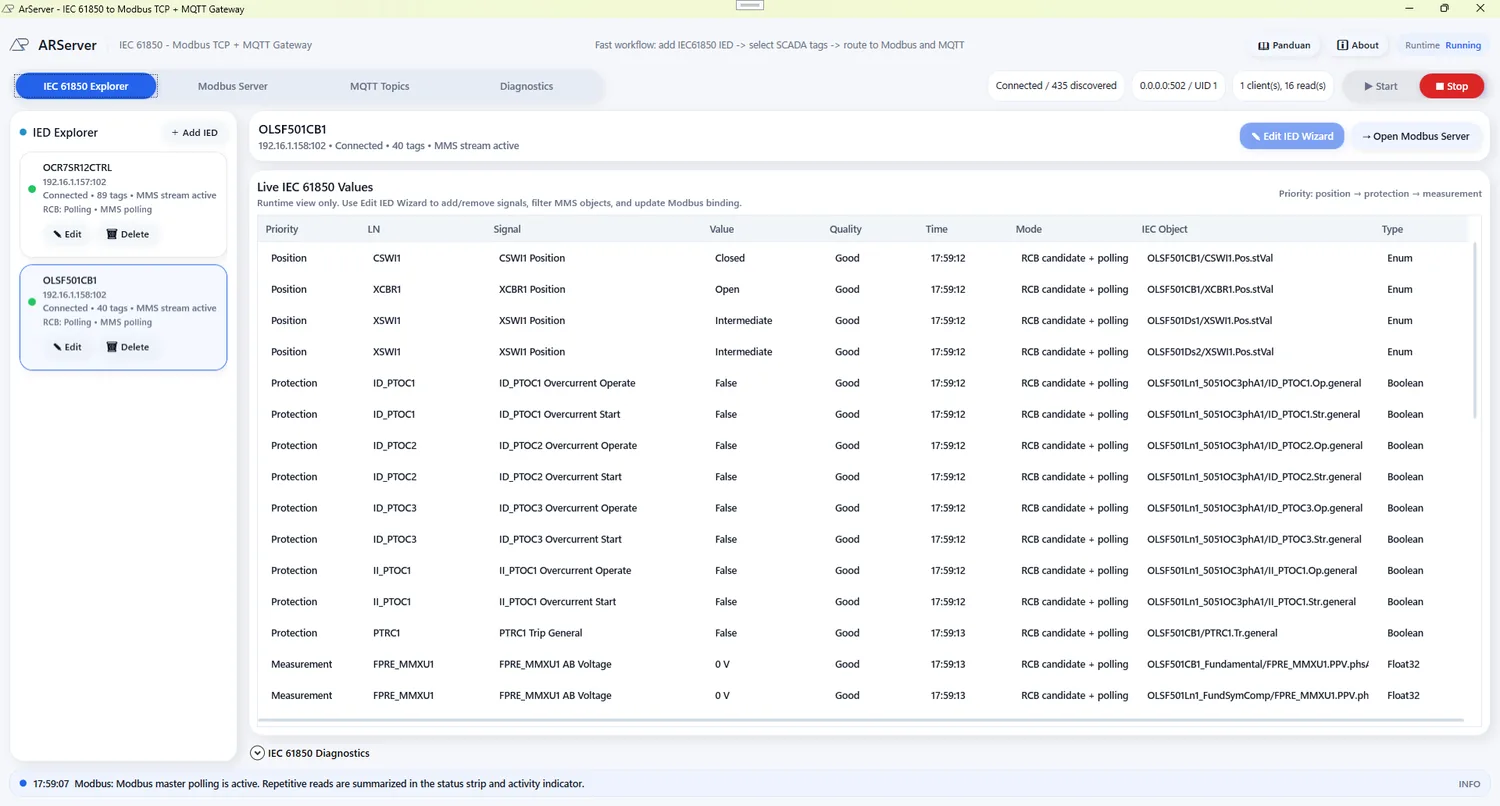
Screenshots help new users understand the start workspace, live IEC values, Modbus server map, and MQTT topic routing before installing.
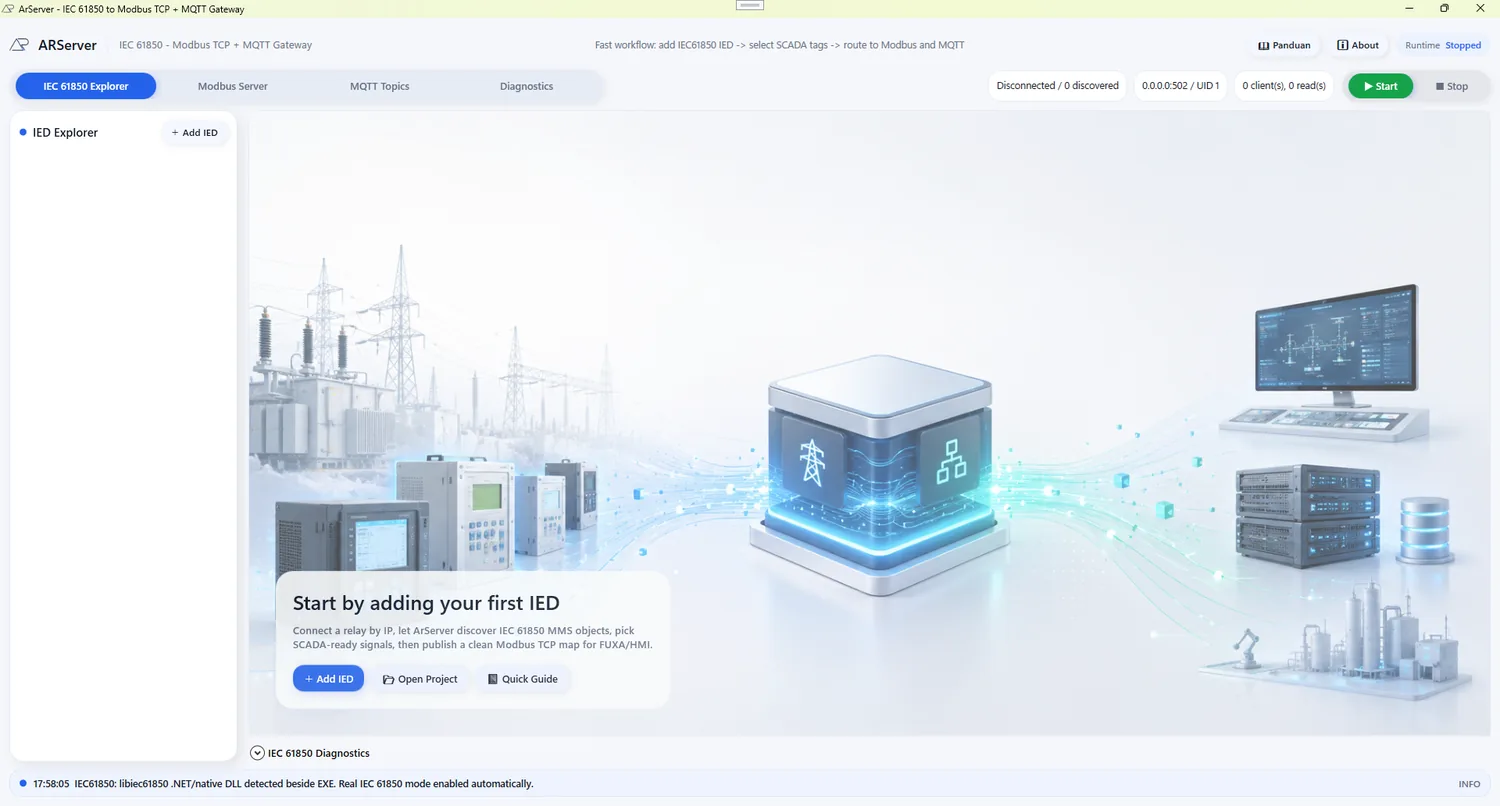
ARServer start workspace
Start workspaceAdd the first IEC 61850 IED and begin the gateway workflow.
ARServer live IEC 61850 values table
Live IEC 61850 valuesValues, quality, object path, and inferred type stay visible.
ARServer Modbus TCP mapping table
Modbus server mapSelected IEC signals become clear Modbus points for HMI polling.
ARServer MQTT topics screen
MQTT topic routingPublish value, quality, status, and state payloads to broker topics.

Product docs

The documentation path for learning and using ARServer.

Open the Markdown preview pages when you need clean reading without raw Markdown syntax.

FAQ

Common questions before trying ARServer.

What is ARServer in simple terms?

ARServer is a Windows gateway that reads selected IEC 61850 relay or IED values and republishes them as Modbus TCP registers and MQTT topics for HMI, SCADA, DCS, dashboard, or test tools.

Is ARServer a relay test set?

No. It is a gateway and engineering workspace for selected data reading, mapping, publishing, and validation.

Can it connect to a real relay or IED?

Yes, when the relay, network, and supported IEC 61850 services allow MMS communication over TCP port 102. Validate on a bench or FAT network first.

Do I need an MQTT broker?

Yes for MQTT output. Modbus TCP output does not require MQTT.

Why are quality and timestamp important?

A Boolean value without quality and timestamp can mislead operators. ARServer keeps value context visible so users can see whether a point is fresh, stale, good, or invalid.

Start small, validate clearly

Build one clean IEC 61850 to Modbus/MQTT mapping, then expand with confidence.